Thursday, July 14, 2011

World At War: Houserule Version of Axis and Allies

This is a copy of the houserules me and another friend developed for Axis and Allies. It uses the 2004 Revised Edition (from here on out listed as A&AR) pieces and the board from the 1984 Classic (A&AC) version. I liked these rules a lot, and we had a lot of good times with them. These rules have been playtested to death, so if you try them out, they're fairly balanced. We started work on an even crazier version of the game, but it is currently in development hell. Read on, and I'll give a brief rundown of the game.
The territory distribution is slightly modified from A&AC. Within the rar package is a folder that shows the amended territory distribution. The two problems you will run into setting up using the map without modification is that a few of the territories change hands, and more than a few change IPC value. This can be fixed with flag markers on the changed territories, and all of the IPC values are listed on the original owner's sheet. Our games tend to have heavy drinking and smoking, so we (I) actually created a map overlay using a clear sheet of acetate and a sharpie. I traced over the entire map, put stickers of country flags for territories that had changed hands, and put on stickers that showed the correct IPC value for each territory so we wouldn't be bogged down with the repetitive stress of looking up the information over and over in game.
Everyone is assigned a country and turn order is determined. Then everyone gets 200 IPC to spend on whatever they want, wherever they want it. This is in addition to two Industrial Complexes and two AA Guns. Any money not spent is given back to the bank before play starts.
The two things that set this version apart are A) it is Free For All and B) there are a ton of cool modifications to the standard Weapons Development system. Being Free For All, it encourages "fuck your neighbor" style play. People declare alliances and it really is only a matter of time before one or the other breaks the pact. I have only played one game that ended in cooperative truce. Usually it turns into two factions that hate one another and it goes to attrition.
I'm not going to write much on the extra content, because it is all there in the file. I will mention my favorite things, though:
1) Industrial Development (the reduction of all unit production costs by 1 IPC) is a fixed IPC amount instead of a random roll as it was in A&AC (it wasn't even in A&AR by the book).
2) Blitzkrieg. The random development chart is still there, but some of them are different. Blitzkrieg allows tanks to burn through two occupied land spaces in one turn, to a three space movement maximum. This is Beast.
3) Super Soldiers. Standard infantry have their attack value raised by 1 and can blitz through one unoccupied space like a standard tank.

...and the Grandaddy of all of them, the reason three out of five shouting matches have broken out at our table is (drum roll):

4) The Motherfucking Chemical Weapon. They are expensive and you have to own one for an entire turn cycle before you can use it, but a Chemical Weapon knocks out a territory for an entire turn cycle. All standard infantry have to fire off a save roll to be able to leave to an adjacent territory they or an ally own. Grounded vehicles, AA Guns and Industrial Complexes in the territory are carted off by surviving infantry at a 1:1 ratio. Anything left in the territory belongs to whomever reenters the territory first after it is safe (this is almost always the person who dropped it). It never fails that someone forgets about who controls one, dumps a ton of planes and/or tanks in an area and pretty much loses the game right there. I have seen one guy (probably no coincidence that he is the other designer) successfully knock out two people in one game with well timed Chemical Weapons.
That's the nutshell sales pitch. If it sounds interesting, download the file and give it a try. Feel free to shoot me questions about it, as well. In a later post I will outline the much more radical changes that we were in the middle of playtesting when everyone got burned out on A&A.

PS: I'm still learning the formatting nuances here, so eventually it won't look as bad as this post did.

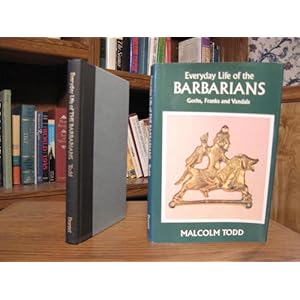
Review: Everyday Life of the Barbarians by Malcolm Todd


Let me get this out of the way right here in the first post. Some of the posts here will be book reviews. I have to compose an average of five professional quality book reviews per month in my real life. The book reviews here will be me speaking as I do in my personal life, noting the things I liked and disliked about a particular book. There will likely be cursing and a hell of a lot of prepositions. This book was a good one to start with, not only because I read it recently, but because it fits the profile of a book I would review in my professional life.
Now that we got that disclaimer out of the way, on to the review.
This book was a synthesis work of archaeology and anecdotal history published sometime in the early eighties, I'd guess. I'm too lazy to look it up, could've been late seventies. It focuses on Goths, Franks and Vandals from a hundred or two years prior to the fall of Rome all the way until the late Dark Ages. The shift in material and metaphysical culture that each of these groups underwent as a result of contact with Rome, the aftermath of defeating Rome, and then living in a Europe that was descending into madness are roughly outlined.
The book is only a couple hundred pages, so you're not getting an exhaustive work here by any means. What you do get is an uneven long form essay. I mentioned earlier that the book sits on two sides of a fence. One side of the fence is anecdotal history, the other side is archaeological analysis. When the two are used in tandem to discuss whatever the hell the topic is on any given page, the book is brilliant. It fails about half the time to do that, however. There are many tracts throughout the text that are either an ass hair away from Paul Bunyan style Tall Tales, or incredibly dry discussion of midden contents. The nice thing about presenting these two together is that you get a grounding effect that makes the history parts less outlandish and also serves to make the archaeological stuff more entertaining. I read archaeological texts for entertainment purposes and I find them boring a lot of the time. A layman would cry himself to sleep reading this stuff, and this book does a good job about half the time making it interesting. I'm not sure if another edition of this got published or not, but it would have benefited from an emphasis on blending the two expository styles together. Inside the dust jacket, you see that there is a whole series of "Daily Lives of x," so it's unlikely that an updated or revised version of this book was ever published.
Now to the meat. Franks were FUCKING BADASSES. I can honestly say that this was the biggest thing I took away from this book. The Franks used a medium-short length throwing lance that had a bunch of barbs on the tip. It was attached to a rope like they do with harpoons. In fact, the thing pretty much looks like a small land harpoon, for catching men. They scared the living shit out of Roman legionnaires. The mental image of a bunch of filthy, screaming Frenchmen bounding out of the woods throwing barbed lances that stick, are pulled out with ropes and rend the shit out of your torso on the way out is BRUTAL. A chapter towards the end of the book shows the evolution of the throwing lance and light armor that the Franks underwent during their battles with the failing Roman Empire. Up until around 400 AD nobody in Europe was wearing any kind of armor unless they were working for Rome or incredibly rich. Best part of the book, by far.
Sometime in the next few days I'll track the book down and scan some images that I liked.